
March 2026
You see, war is not the answer – for only love can conquer hate
Dear Faith for the Climate network,
Greetings and welcome to our March update. In early 2022, after all that Faith for the Climate achieved at COP26, the UN climate talks in Glasgow, I thought we had developed a good direction with our climate justice priorities. We would continue supporting the diverse climate and nature actions that our members were passionate about – from restoring nature to sustainable fashion – but our core team would also generate our own priorities, based on our COP26 learnings. We would call for, first, a just transition away from fossil fuels towards renewables and, second, fair and sufficient finance for climate-induced loss and damage.
While these priorities remain relevant, little did I anticipate how war would become yet another elephant in the billionaire-built and fossil-fueled room. Starting with the Russian invasion of Ukraine, we started including updates on the climate and environmental impacts of war, such as the destruction of the Khakovka Dam in 2023. We’ve shared ground-breaking research on the carbon emissions and other environmental impacts of the military-related activities of Israel and its allies in Palestine. We’ve also showcased innovative, faith-inspired solutions, including our webinar during the 2024 Global Week of Action for Peace and Climate Justice on the potential for interfaith collaborations to foster peace and ecological justice.
Yet war continues to loom large, including in Sudan, the Democratic Republic of Congo, Pakistan, Afghanistan, and now, terrifyingly, the US- and Israeli-led strikes on Iran and Iran’s responses which are affecting the wider Middle East. What do we do?
When news of the war on Iran broke, in my head I started hearing the words of the Prince of Soul, Marvin Gaye – ‘war is not the answer, for only love can conquer hate’. Then this week, when I started compiling the materials for this update, I came across a graphic from the Together Alliance that said, ‘Love is stronger than hate.’ I felt something stirring deep within me.
If you’re feeling helpless, angry, or fearful, perhaps take some time to watch this updated video of ‘What’s Going On’, and then read on for details of how you can join the faith bloc at the Together Alliance gathering in London on Saturday, 28 March.
‘What’s Going On’ (Official Video 2019)
Besides being a brilliant song, ‘What’s Going On’ is also, for me, a perfect spiritual accompaniment for Ramadan and Lent. In a couple of weeks, Muslims will be celebrating the end of the holy month of Ramadan by marking Eid Al-Fitr, the Festival of Breaking the Fast.
‘Eid’ means ‘holiday’ or ‘festival’ while ‘fitr’, especially when rendered as its derivative, ‘fitrah’, means something like ‘innate disposition’ or ‘essence’. In other words, the practices cultivated during Ramadan – including fasting, prayer, reciting the Qur’an, and charitable giving – are meant to remind Muslims of humanity’s true essence which is ordained by God, who is Al-Rahman and Al-Rahim, merciful to all and compassionate to each.
In the Islamic tradition, it was during Ramadan that the first verses of the Qur’an were revealed by God to the Prophet Muhammad (peace be upon him) through the Angel Gabriel as an intermediary. This happened one night during Muhammad’s spiritual retreat, or seclusion, in the cave of Hira just outside Mecca in the Arabian peninsula. This experience was anything but comforting. When Gabriel uttered a single-word command – ‘Read!’ – Muhammad protested, since he was illiterate, ‘I am no reader!’ According to one tradition, the angel then forcibly held Muhammad and ‘pressed’ him so hard that he felt ‘distressed’. This happened three times before Muhammad was miraculously able to transcribe unto his heart and recite the verses that would later form the opening of the 96th chapter of the holy book of Islam, the Qur’an.
Yet Muhammad’s terror did not end there. According to Islamic tradition, Muhammad returned home discombobulated and overwhelmed, seeking solace from his wife Khadija. She not only believed him but believed in him and became his strongest source of love and support until she died a decade later. Thus began Muhammad’s prophetic mission, quietly and tentatively at first before growing over the next 23 years.
According to the Qur’an, Muhammad was not alone in experiencing this combination of reluctance, fear, and disorientation when receiving the divine revelation. Moses, the Virgin Mary, Jonah, and many other prophets and messengers were also assailed by doubt and distress upon first hearing God’s command before they eventually obeyed.
I relate this story not as a truth to be imposed on anyone. I share it to explain what I mean when I say that faith gives me comfort and inspiration during times of trouble. Comfort is not always synonymous with feeling cuddled or lullabied by God. Rather, comfort from faith can come as a jarring, transformative discomfort.
News of war is always a shock to my system – mine is a generation whose coming of age was defined by the Iran-Iraq war, the first and second Palestinian Intifadas, the first and second Gulf Wars, the Bosnian and Rwandan genocides, and the Sierra Leone civil war. But religious and spiritual inspirations – including scripture, prayer, fasting, and Motown classics – provoke a different kind of discomfort and shock. This is the purifying discomfort and shock of remembering the essence of our faith amidst wars and rumours of war – only love can conquer hate.
Join us at the Together Alliance on 28 March if you can, and read on for more actions, events, and resources to fortify the essence of your faith.
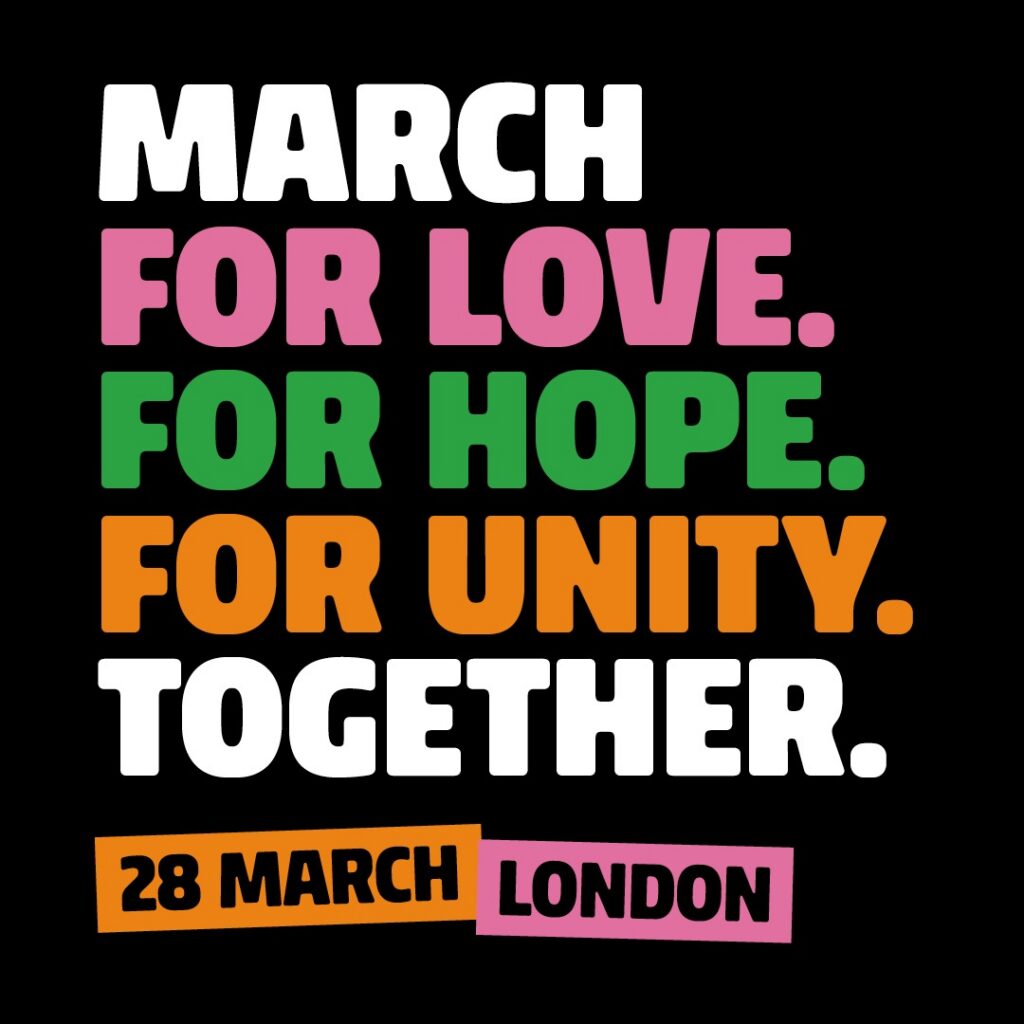
Stand together for hope and unity
You already know that the far-right is sowing hate and division throughout this country.
Faith for the Climate has joined Together, an alliance of hundreds of civil society organisations representing over 7 million people, committed to rejecting these narratives and showing that the change we need comes from us working together for hope not despair, for unity not racism.
We need people of all faiths and beliefs to show that we want a world of justice, peace, and kindness. Add your name to the Together Alliance statement to help us build it.
If you want to join the faith bloc on Saturday, 28 March, please get in touch with Canon Giles Goddard for more information.

Host a community screening of the People's Emergency Briefing
Last year, we mobilised faith support for the National Emergency Briefing (NEB), a non-partisan public-information initiative bringing together leading UK experts to present clear, evidence-based briefings on the climate and nature emergency. Following the landmark briefing in Westminster last November, NEB is now rolling out a 45-minute public-information film, the Peoples Emergency Briefing, for local screenings across the UK, available from 7 April.
Organisers are supported with a full toolkit, including the film, guidance and digital publicity assets. Faith communities and places of worship are most welcome to register interest or find out more at nebriefing.org/take-action, or contact info@nebriefing.org.
To refresh your memory, I would highly recommend reading this beautiful reflection of the November briefing by Elizabeth Cruse from the Order of Bards, Ovates and Druids.
Other actions
- Take 2 minutes with this handy online tool to send a postcard to your MP/MSP to #StopRosebank and all new oil and gas fields
- Sign this petition from JustMoney Movement for
fairer, greener pensions - If doomscrolling social media has you feeling hopeless that the UK is more divided than ever, the antidote is to inspire and celebrate A Million Acts of Hope this May
Upcoming events
Wednesday, 25 March (online): One of the great wellsprings of social justice worldwide has been the commitment of people of faith to making this world a better place for everyone. Today, as we face the challenges of growing narratives of division, and as some of the most divisive figures begin to present their prejudice in religious terminology, the Ella Baker School of Organising is reaching out to people of all faiths to explore how we can better reach faith audiences with our messages of hope and unity. Find out more and register here.
Saturday, 30 May – Sunday, 31 May (in person): The Laudato Si’ Research Institute, in collaboration with the Al Mahdi Institute and the Cambridge Muslim College are organising a two-day formation course, Christian-Muslim Dialogues on Ecology. The course aims at equipping Muslim and Christian communities with the intellectual and theological resources to learn from each other and respond together to today’s ecological and political challenges. Find out more and register here.
Resources: Militarism and climate justice
Even with all the actions and events I’ve already listed, it can still feel horrible having to sit and watch while the planet burns and geopolitics unravels with such vengeance. Not least because we are also increasingly inundated with distortions and disinformation about current events. At times like this, taking the time to learn from in-depth information resources, if only to clarify our own thinking, is sacred work. These are a few resources that I’m happy to recommend on the links between militarism and climate injustice:
- The Arms, Militarism and Climate Justice working group is an informal network of researchers and activists committed to ending militarisation of the climate crisis and hosts excellent information resources on militarism and the climate crisis
- Based in the Christian tradition, the Fellowship of Reconciliation is an international movement of people who commit themselves to active nonviolence as a way of life and as a means of personal, social, economic and political transformation – check out their resources on war, militarism, and the climate crisis
- The concept of ‘national security’ can often become a pretext for scapegoating minorities within national borders and demonising immigrants and foreigners. Find out how Rethinking Security are redefining this concept so that it is grounded in the well-being of people and planet, and rooted in solidarity, justice and appreciation of our inter-dependence
- Transform Defence for Sustainable Human Safety describes the paradigm shift we will need to meet demands for climate justice by halting runaway military spending
Other resources
The war in Iran is only the latest military conflict that demonstrates why we must move away from dirty fossil fuel energy. This article explains why the strikes on Iran show that quitting oil is more urgent than ever. It’s not that the world will magically become a peaceful utopia with no geopolitical tensions at all if there was a meaningful transition to renewables. For example, there would still be a scramble for the critical minerals needed to produce renewable energy sources and infrastructures. Even so, geopolitical conflicts would look a lot less catastrophic, as this scholarly thought experiment suggests.
Meanwhile, the Trump administration has not stopped making headlines since 2026 began, from its handling of protests within the borders of the US to its withdrawal from the UN convention on climate change and its threats – potential and realised – against several nation-states and territories, including Venezuela, Greenland, Nigeria, Iran, and Cuba. You can be forgiven if you missed a crucial update in relation to climate injustice – the Environmental Protection Agency’s repealing of the legal basis for regulating climate-wrecking greenhouse gas emissions, also known as the ‘endangerment finding‘. Guess who wins? The fossil fuel industry and the governments that profit from it, of course. Guess who loses? Everyone else.
The UK government is also backtracking from its commitments to protect nature and vital ecosystems around the world. This is why Faith for the Climate is one of 85 organisations calling on Prime Minister Sir Keir Starmer to intervene and increase climate funding, raising the money by taxing fossil fuel producers. Read more to find out how schemes worth hundreds and billions of pounds to protect biodiversity and oceans are likely to be slashed.
As concerning as these developments are, they are crucial to understand if we are to address them meaningfully and successfully. And faith has the potential to inspire profound shifts, especially in the form of interfaith sharings and friendship. I was very moved by this joint reflection on Lent, Ramadan and Creation care by Kamran Shezad, Director of the Islamic Foundation for Ecology and Environmental Sciences and the Rt Revd Graham Usher, Bishop of Norwich and Church of England lead bishop for the environment.
Thank you for reading this far, and well done for all that you do for people and planet. In honour of the Together Alliance and the gathering in London on Saturday, 28 March, I’ll give the last word to Marvin Gaye:
Picket lines, picket signs – don’t punish me with brutality
Shanon Shah
Director at Faith for the Climate
About Faith for the Climate's monthly e-news
Faith for the Climate exists to encourage, inspire and equip faith communities in their work on climate change. If you have any items you would like to be included in upcoming editions of our newsletter, contact us, find us on Facebook, Instagram, and LinkedIn. Subscribe to our e-news here.