
Every moment is the perfect moment for climate justice
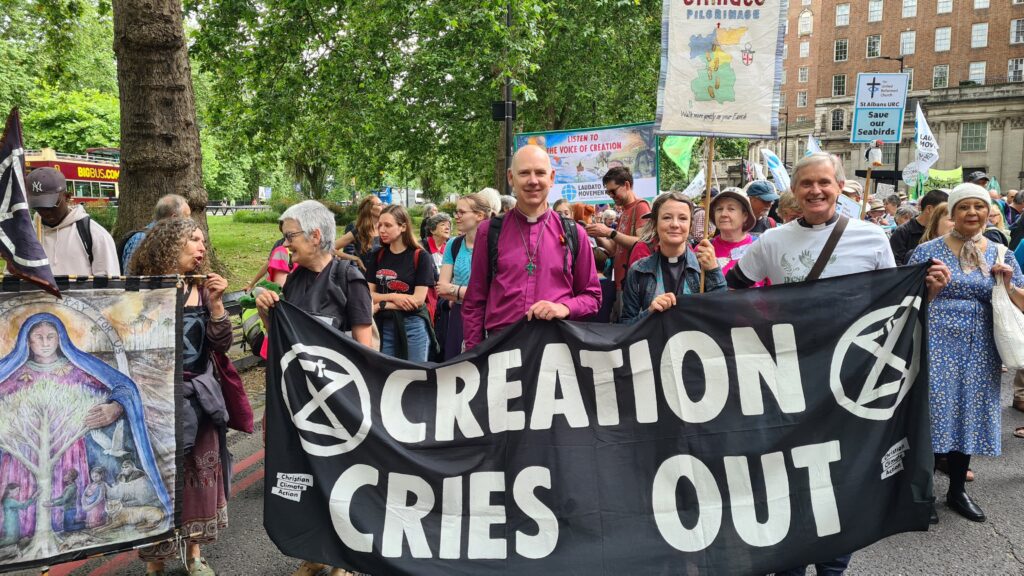
‘Creation Cries Out’: Christian Climate Action as part of Restore Nature Now, 22 June 2024 (pic: Shanon Shah)
Dear Faith for the Climate network,
This monthly update is arriving in your inboxes later than usual, but I’m too excited to even apologise. These past couple of months, we have not only reflected on how to build on but also how to communicate our impact. Part of this has involved re-visioning our e-news, website, and other communications channels. I’m therefore hugely excited to welcome you to our new and improved website.
I’ll try not to say much more, because I’d like you to visit it and soak up the love and care that has gone into this refreshed design by a stellar team – Marley Muirhead (creative lead and copywriter), Jamie Ghatt (web developer) and Lawrence Slater (illustrator). It’s not just meant to be warmer and prettier – we also want the website to become a more user-friendly resource that is true to our inclusive faith-based identity. If you’re interested, you can also read the finalised report of the impact assessment that we carried out over the summer, written by Anu Priya and Farha Bi [link to report on website]. I’d love to hear what you think.
You’ll be hearing a lot more about what we have in store over the coming months, so I’ll keep this introduction short for now. Below, you will find our usual update of events, actions and resources that you can get stuck into. But before that, here’s a bit of spiritual grounding.
Spiritual grounding: The perfect moment for climate justice?
This month has already seen an abundance of sacred festivals that embody creative renewal and wonder. The 1st of September saw the commemoration of the birth of the first rendition of the Sikh holy scripture, known as the Adi Granth, compiled by the fifth guru, Guru Arjan. This was soon followed two joyous Hindu festivals – Krishna Janmashtami (4 September), celebrating the birth of Krishna who is also known as the supreme God and source of all avatars, and Ganesh Chaturthi (14 September), celebrating the birth of the elephant-headed Lord Ganesha.
Coinciding with Ganesh Chaturthi this year were the Christian Feast of the Holy Cross and Rosh HaShanah, the Jewish New Year, which marked the beginning of the High Holy Days culminating in Yom Kippur, the Day of Atonement on 20 September.
This week will mark the start of Sukkot (25 September), the Jewish harvest festival known as the Feast of Tabernacles, and Michaelmas (29 September), the Latinate or Western Christian festival honouring the Archangel Michael, best known for defeating Satan in the War in Heaven.
My best wishes go to any of our members marking these sacred commemorations in any way. I find it particularly profound that these dates fall during the month-long ecumenical Christian Season of Creation, bringing interfaith depth and variety to what ‘Creation’ means.
As inspired as I am to mark all these sacred observances, I cannot help but feel more anxious than usual. This sacred season arrives after a summer of not one or two but several unprecedented heatwaves in Europe as well as catastrophic flooding in Nepal and Tibet, not to mention other ongoing genocides, ecocides, and injustices. The polycrisis deepens.
At times, I wonder if whatever we do will ever be enough, or if what I do personally or who I am as a person will ever be enough – especially in the light of such colossal obstacles to planetary justice, healing, and repair. Will I ever find that perfect formula for climate justice now?
Here’s where, for me at least, the spiritual and personal meets the public and political. Our website redesign might seem like an insignificant endeavour amid the greater need to tackle the polycrisis.
I’ve had to pause and remind myself that historically in the Islamic tradition, works of art were often acts of devotion expressed in intricate, painstakingly created designs. We can observe many examples of these in mosques, tiled murals, ceramics, and even fabrics, rugs, and jewellery.
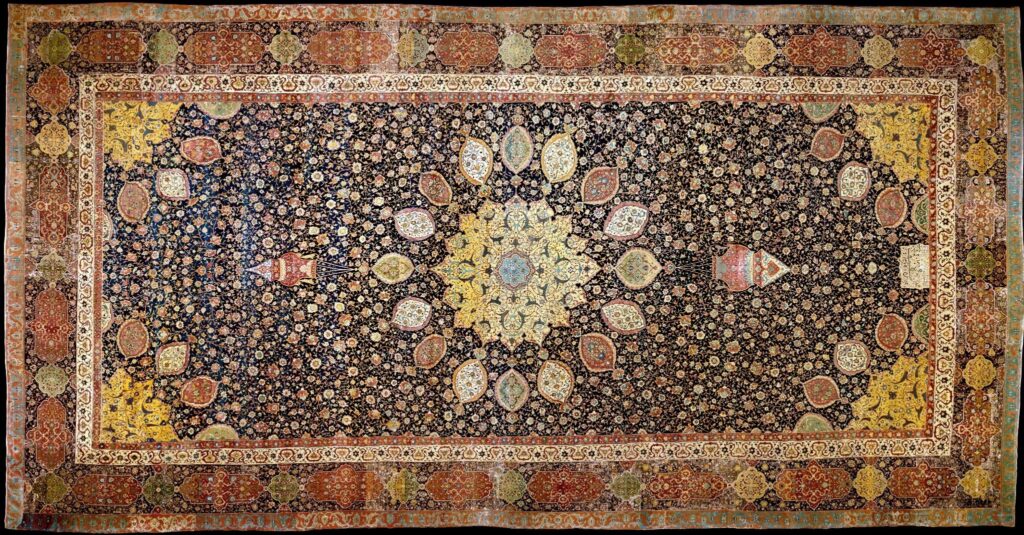
Ardabil Carpet 1539-40, the world’s oldest dated carpet, by Maqsud of Kashan (1539-40 CE), which can be viewed at the Victoria and Albert Museum in London (public domain)

Look more closely, however, and you might notice that a rug with a floral theme might have a corner in which the design looks a bit off. According to some perspectives, it would be a mistake to consider a mistake like this an actual mistake. Rather, visual art in Muslim cultures is often characterised by such flaws, deliberately introduced by the artisan to symbolise that only God is perfect.
The artistic-cum-theological reasoning goes something like this: if humans try to create something flawless or if we think that we are perfect because we’ve created something supposedly flawless, then this is the definition of arrogance. It is our human imperfections that make us humble, and this humility is the necessary purifying ingredient for all our actions and intentions, which are always works in progress. This is why constant and regular spiritual practices are so important – they allow us, as flawed, limited, and wounded human agents, to actively participate in the cosmic, sacred process of purifying our souls, individually and collectively.
This next step in our journey at Faith for the Climate does not mark our discovery of some perfect moment or formula for climate justice. Rather, it is an act of creative spirituality and spiritual creativity. It is a work in progress – a work of art, even, made more beautiful by the humble hopes and concerns that we all bring to our work. Because every moment is the perfect moment for climate justice.
Upcoming events: Ahista Stories Live (18 October)
Ahista Stories Live, London’s only South Asian sustainable fashion festival is back for a fourth year with talks, workshops and an exhibition, on Sunday, 18 October. Faith for the Climate is a proud co-sponsor of this year’s festival and will be holding a special Faiths for Climate Justice workshop from 15:30 to 17:30.
Take action: Stop Dirty Data Centres
If you’re a regular reader of our newsletter updates, discussions about Artificial Intelligence (AI) and its environmental and other discontents should come as no surprise. What might come as more of a shock is the scale and speed at which AI data centres are being financed and built in the UK. Sign this petition to the UK government if you’re concerned about the rise of dirty data centres.
Resources
Together with more than 50 civil society organisations, we have signed an open letter calling on the UK and EU governments to end the use of biofuels in specific sectors to mitigate the looming food crisis resulting from worsening climate change. Biofuels are not the enemy in and of themselves but, as with many climate and nature solutions, how they are grown, sourced, and governed must always be scrutinised through the lens of justice and equity. Here’s a helpful briefing by the International Union for Conservation of Nature and Natural Resources (IUCN) on biofuels and biodiversity.
The Season of Creation closes on 4 October, which is the Feast of St Francis, the 13th century eco-mystic. This is also Good Money Sunday, a chance for collective prayer and reflection on the ethical and just use of money. If you are interested in joining the dots between the legacy of St Francis and ethical finance, sign up to receive JustMoney Movement’s resource pack for Good Money Sunday.
Can lawsuits hold fossil fuel companies responsible for the impacts of the climate crisis? We shall find out. Read about how Misti Leon, from Washington State in the US, is suing several oil and gas giants for the 2021 heat-related death of her mother Juliana, who died during a record-breaking heat dome over the Pacific Northwest. Meanwhile, grassroots campaigners in the Philippines are taking Shell to court to hold it accountable for Super Typhoon Odette, also in 2021.
Thank you for reading this far, and for all that you do, sacred and secular, for people and planet. You will be hearing from me again very soon with a series of exciting new updates. For now, I’d like to give the last word this time to the Indian-American Sikh activist, filmmaker and writer Valarie Kaur. Here’s an excerpt of her beautiful personal reflection of the Guru Granth Sahib, grounded in childhood memories of her grandfather:
As I fell asleep each night, Papa Ji would sing the Mool Mantr, the foundational verse that opens the Guru Granth Sahib, our sacred canon of musical wisdom. It begins with the utterance ‘Ik Onkar,’ which means Oneness, ever-unfolding. ‘All of Sikh wisdom flows from here,’ Papa Ji would say. All of us are part of the One. Separateness is an illusion: There is no essential separateness between you and me, you and other people, you and other species, or you and the trees. You can look at anyone or anything and say: You are a part of me I do not yet know.
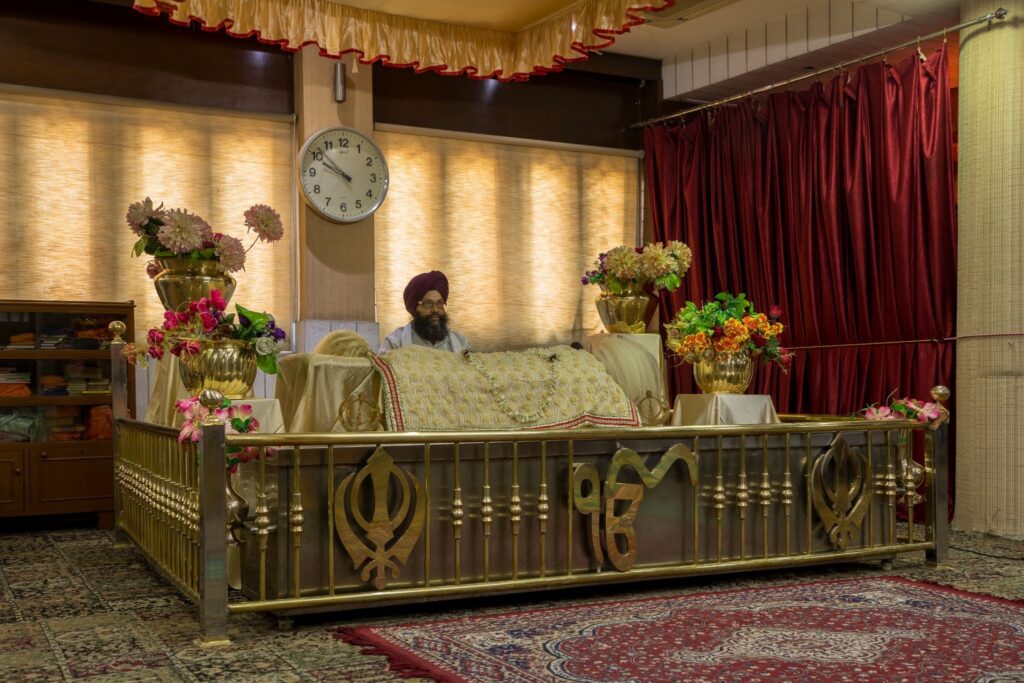
The Guru Granth Sahib, the holy book of the Sikhs, inside the Gurudwara Bara Sikh Sangat in Kolkata (by DeepanjanGhosh)

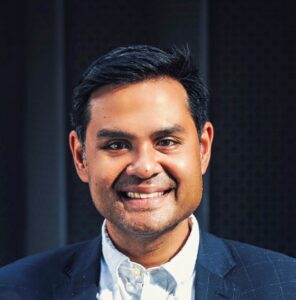
Shanon Shah
Director at Faith for the Climate
About Faith for the Climate's monthly e-news
Faith for the Climate exists to encourage, inspire and equip faith communities in their work on climate change. If you have any items you would like to be included in upcoming editions of our newsletter, contact us, find us on Facebook, Instagram, and LinkedIn. Subscribe to our e-news here.