
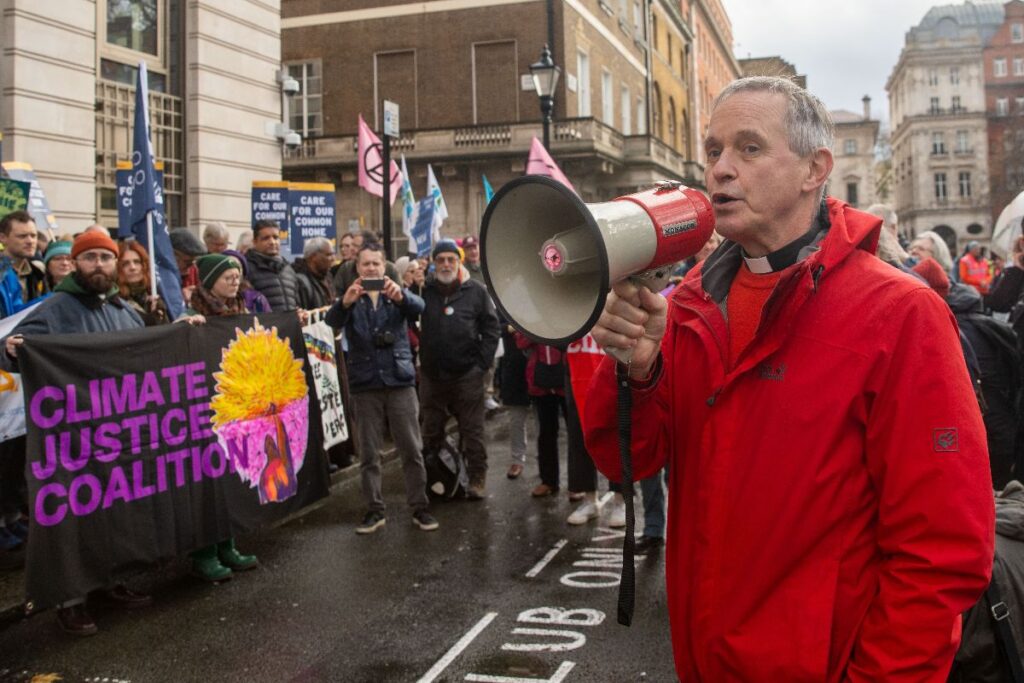
Our chair and co-founder Canon Giles Goddard addressing the faith bloc at the COP28 Global Day of Action in London, 9 Dec 2023 (pic by Shanon Shah)
Dear Faith for the Climate network,
November is probably when I send out my lengthiest monthly updates because it’s always That Time of the Year — when the UN climate talks (COP) and Inter Faith Week overlap. That’s why last week you all received a bumper e-news that was full to bursting with actions, events, and resources. Congratulations if you read it all the way to the end!
Huge thanks to those of you who responded to our call for interest in a post-COP30 debrief specifically for faith communities in the UK — which people of all faiths and beliefs are welcome to join, of course. In case you missed it, it’s not too late to help us plan — we look forward to your responses before 23 November:
The rest of this email is a leaner, more focused update on COP30 in the context of Inter Faith Week, just in case you missed the main highlights from last week. Scroll down for the main actions you can join, followed by a non-exhaustive COP30 background reading list.
COP30 and Inter Faith Week main actions and events
If you’d like to join COP30-related solidarity actions, check and sign up for the one nearest you through this interactive map. Visit our special page for the latest information on faith-specific COP30 actions and events as well. You can also check the Inter Faith Week website for specifically interfaith events and actions related to climate and nature.
I’d like to bring your attention to faith involvement at the COP30 Global Day of Action this Saturday, 15 November:
This shouldn’t be news but it’s worth repeating — the obstacles to climate justice and other forms of justice at international climate negotiations are the same obstacles to climate and environmental justice within the UK.
That’s why in September, we marched alongside thousands of people as part of Make Them Pay, an alliance representing millions of workers, citizens and communities across Britain. Our demands were simple: tax the super-rich, protect workers not billionaires, and make polluters pay.
These demands remain as relevant globally at COP30 as in Britain.
Watch the video of the Make Them Pay mobilisation last September
A COP30 background reading list
Every single United Nations climate conference (COP) comes with fierce criticism. But how do we distinguish between criticisms that are fair and rooted in climate justice from those that are made in bad faith?
In this section, you’ll find bite-sized articles and videos that explain what is at stake in as jargon-free a manner as possible. They’re not detailed policy briefs, but bigger picture pieces that can help us join the dots between the different priorities at COP30 and beyond.
First, a series of articles to set the scene:
- This Big Issue feature lays out the main issues at stake at COP30
- This article in The Conversation argues that UN climate summits do work, just not in the way that their staunchest critics think
- UN climate talks don’t occur in isolation — they are part of a global climate justice movement with growing momentum. To refresh your memory, in July this year, the International Court of Justice (ICJ) issued a landmark opinion affirming that national governments have a binding legal duty to prevent climate harm and protect human rights from the impacts of climate change
One recurring criticism of the the climate COPs that is well-evidenced is the presence of lobbyists from the fossil fuel industry that have played a significant role in blocking progress. This interference and influence of big polluters at UN conferences has a long and shady history.
- The Guardian, with the help of DeSmog, has exposed how Exxon funded thinktanks to spread climate denial in Latin America
- The longer version of this investigative piece by DeSmog meticulously shows the copies of cheques Exxon mailed to the Atlas Network in the 1990s to turn Latin America against climate treaties
- COP30 also coincides with the 30th anniversary of the execution of the Ogoni Nine — environmental activists in Nigeria, led by Ken Saro-Wiwa, who were fighting peacefully to protect the Niger Delta from oil giant Shell. Noo Saro-Wiwa’s reflection about her father’s legacy is a must-read.
Ever since we mobilised interfaith involvement at COP26 in Glasgow, 2021, Faith for the Climate has highlighted the urgency of addressing climate-related loss and damage. In recent years, faith groups have been making the case for addressing non-economic loss and damage — the social, psychological, cultural, and spiritual impacts of the loss of homes, loss of territory, loss of cultural heritage, loss of local knowledge, and loss of loved ones due to climate-related disasters.
- This blog by Franciscans International traces the history of discussions about non-economic loss and damage at the UN
- In the wake of Hurricane Melissa in the Caribbean, Cyclone Montha in South Asia, and Typhoon Fung-wong in the Philippines, this article in The Conversation explains the psychological costs of major storms, including ‘environmental grief’ and ‘deep anticipatory anxiety’
Amid the headlines of genocide and war in Gaza, Sudan, the Democratic Republic of Congo, and Ukraine in recent years, military emissions are worsening climate change significantly — yet they remain obscenely under-reported.
- This blog by the Conflict and Environment Observatory explores how, at a time of growing military spending, the expanding military emissions gap is undermining climate accounting and ambition
Against this backdrop, there is growing recognition of the profitability of the renewable energy sector. Unfortunately, this is increasingly taking the form of rich countries in the Global North rushing to the Global South to extract the minerals, labour, and materials needed for their renewable energy transitions.
How do we distinguish between false, unjust solutions to the climate and nature crises and real solutions? In June, Faith for the Climate hosted a two-part webinar as part of the Great Big Green Week that remains a relevant and informative primer.
Watch Part One, on what makes a climate solution ‘false’ – and how to spot its main characteristics with real-life examples.
Watch Part Two, on how to identify real or true climate solutions, with specific real-life examples.
More Resources
If you need further sustenance, why not read our in-depth profiles of the global-majority friends within our network? We’ve spoken to beautiful souls who reflect on climate justice, racial justice, faith and spirituality, joy, and many other topics to inspire and fortify us.
We published profiles of rehena Harilall and Dionne Gravesande during Black History Month, and today we’re thrilled to publish the first part of our interview with Bokani Tshidzu.
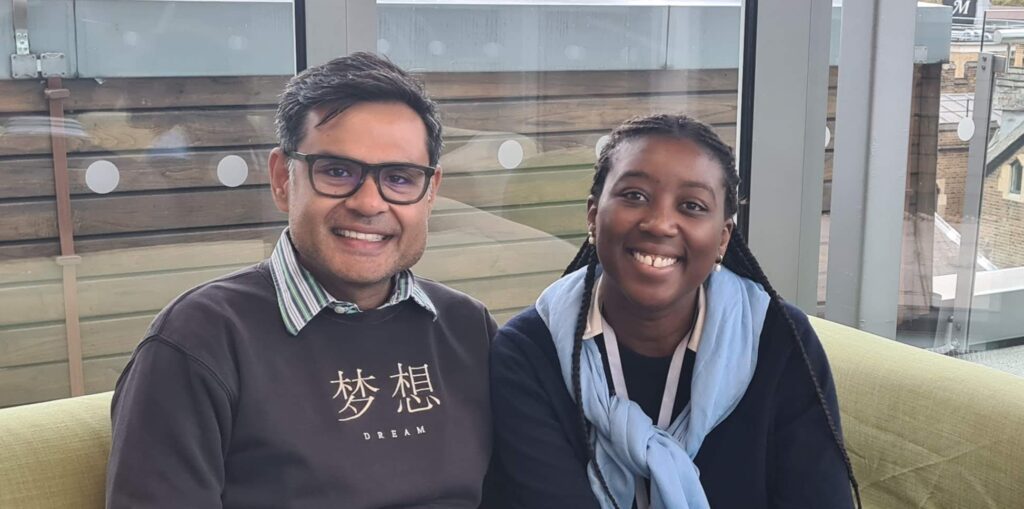
Me and Bokani having a lovely long chat at Romero House last month
A post-COP30 debrief?
As I said at the beginning of this update, we want to host a special post-COP30 webinar and make this as meaningful as possible to you.
If this sounds useful and interesting, please click the button below and take 2 minutes to help us organise it. The deadline for responses the end of Sunday, 23 November 2025. Based on the feedback we receive, we will announce further details soon.
Thank you for reading this far, and for all that you do for people and planet. I’d like to end this special edition with something that I hope you can adapt for your own prayers, meditations and reflections during this period. It’s a prayer by the Most Reverend Marinez Bassotto, a Brazilian and the first female primate of the Anglican church in Latin America:
Breath of Life, from whom all order was created,
the whole of creation bears witness to you.
Teach us to respect all creatures,
increase our gratitude for your loving providence.
Forgive us for our insensitivity and carelessness with the environment.
Instigate us to fight for socio-environmental preservation
and for the end of the climate crisis,
taking care and working for the preservation of species
and the maintenance of life on earth.

Shanon Shah
Director at Faith for the Climate
About Faith for the Climate's monthly e-news
Faith for the Climate exists to encourage, inspire and equip faith communities in their work on climate change. If you have any items you would like to be included in upcoming editions of our newsletter, contact us, find us on Facebook, Instagram, and LinkedIn. Subscribe to our e-news here.